Description
Have you ever been to a party where one uninvited guest shows up and gradually pushes everyone else out? That’s exactly what happens when species cross borders — intentionally or not — and it’s playing out right now in ecosystems across the globe.
Not all newcomers cause trouble. Introduced species can quietly establish themselves without upsetting the ecological balance. But invasive species are a different story entirely. They overcolonize, out-compete, and overwhelm native populations — triggering a domino effect that can destroy entire ecosystems, damage economies and even disrupt man-made systems.
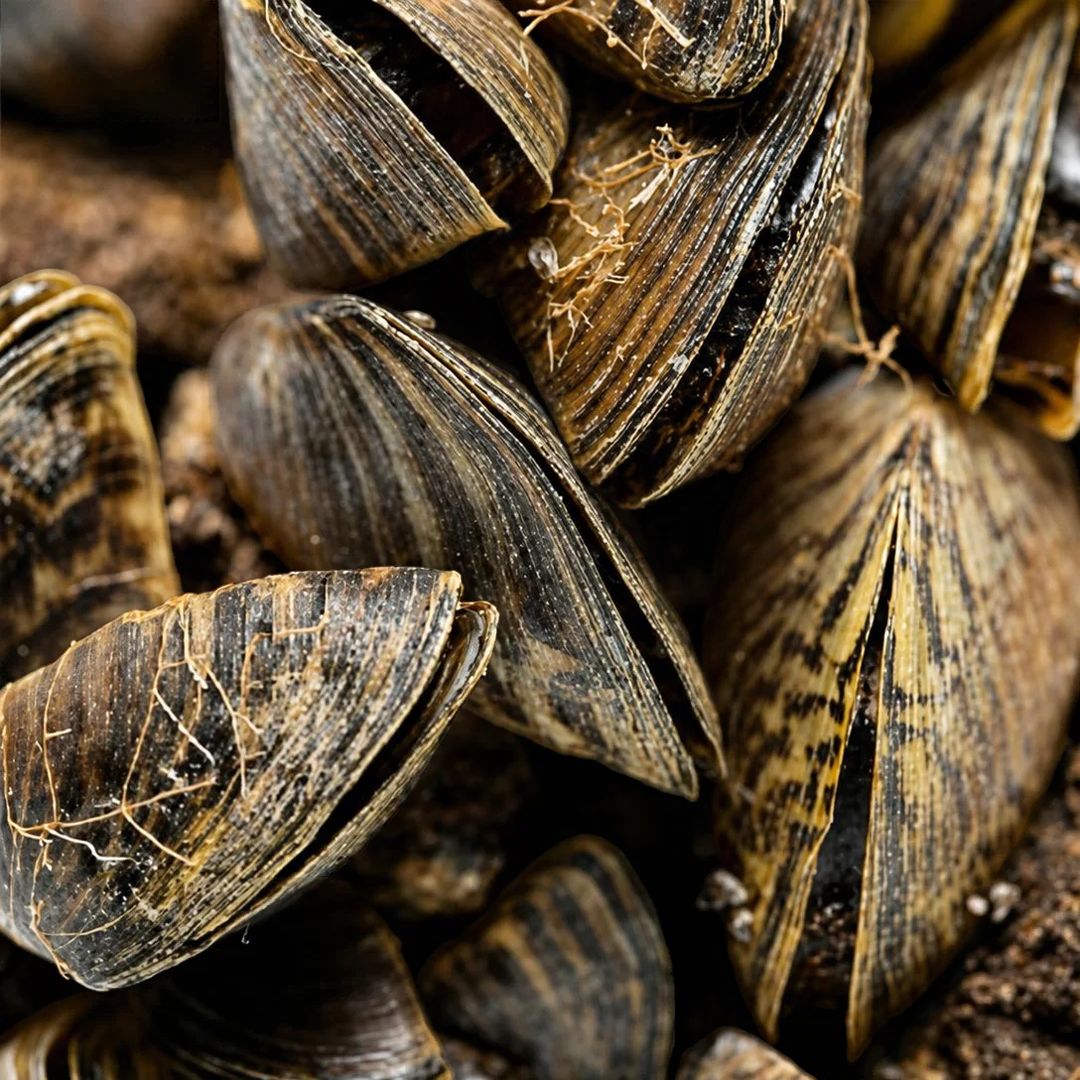
Enter the mussel. Small, unassuming, and wildly underappreciated, mussels play an enormous role in our ecology. As filter feeders, they clean enormous volumes of water, making them critical to the health of both freshwater and marine environments around the world. They’re also delicious, and are farmed and harvested globally as a sustainable seafood source. In the United States, two species dominate aquaculture: Mytilus edulis, the Prince Edward Island mussel, and Mytilus galloprovincialis, the Mediterranean mussel. A third species, Mytilus trossulus — the Pacific Blue or Bay mussel — is native to the Northern Pacific, North Atlantic, Baltic Sea, and Arctic Ocean, and is also farmed in certain regions.
But here’s where it gets complicated. What happens when a farm begins cultivating a non-native mussel species upstream from a wild native mussel population? What happens when a cargo ship discharges ballast water carrying mussel larvae from one part of the world into a different part? Or a recreational boat trip unknowingly transports mussels stuck to the boat from one lake to another? Could a well-intentioned aquaculture operation, a ship bringing critical trade goods or a vacationer accidentally trigger ecological disaster?
In this investigation, students use PCR and DNA electrophoresis to amplify a gene for a mussel adhesion protein, allows them to genetically identify and distinguish between three Mytilus species, M. edulis, M. galloprovincialis, and M. trossulus, and engage in a conversation about the impacts of introducing new species into environments.
This MiniLab is adapted from the Distinguishing Introduced vs. Local Mussels through DNA Analysis activity from the Science Education Partnership (SEP) program at the Fred Hutch Cancer Center in Seattle, WA. The SEP program provides additional background materials for this lab These resources can be found at the Science Education Partnership web page.
***Protocol Compatibility Notice***:
Unlike other labs created in collaboration with the SEP, the Don’t Move a Mussel MiniLab features distinct protocols tailored to specific reagent sets;
MiniOne reagents must be paired with the MiniOne protocol.
Fred Hutch SEP reagents must be paired with the Fred Hutch SEP protocol.
To avoid mismatched run conditions and unexpected gel results, please make sure your lab manual matches your reagent source.
Materials include (enough to genotype up to 40 mussels or mussel tissue):
- FastTaq Master Mix with Loading Dye
- Extraction Buffer
- 1X TE Buffer
- Forward and Reverse Primer Set (ME15/16)
- One bag of PCR Tubes
- One bag of 0.65 mL microcentrifuge tubes
- Tissue Grinders
- Ten 2% agarose GreenGel™ GelCups
- One bottle of 100 mL Tris-Acetate-EDTA (TAE) buffer concentrate, enough to make 2L of 1X running buffer
- MiniOne PCR Marker